


British Racing Green
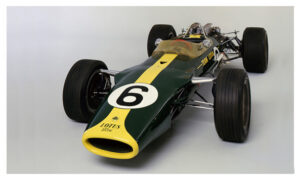
Even though the only colour to be associated with racing cars in the modern era is the red of Italy, a shade of which always has been and always will be proudly worn by Ferrari Formula One cars, there was a time when cars of every competing nation in motor sport were allocated their own colour.
At the very dawn of motoring and, therefore, of competition motor sport, it was suggested that competing countries should have their cars painted in specific colours to help spectators identify them. In the early days, drivers competed for national as much as for personal glory.
The first time this happened was in the Gordon Bennett Cup races, held annually between 1900 and 1905. Count Eliot Zborowski suggested the scheme and colours were allotted; blue for France, yellow for Belgium, white for Germany and red for the United States. Great Britain entered racing in 1902 but was unable to use any of the colours of its national flag – red, white or blue – as they had already been allocated. When a Napier car won the Gordon Bennett race in that year, it was painted olive green, which was coincidentally a well-established colour for locomotives and other heavy industrial machinery, in which Great Britain at that time led the world.
When Great Britain hosted the 1903 Gordon Bennett Cup race, the British teams adopted Shamrock Green as their racing colour, which would evolve into British Racing Green in the years that followed. Italy adopted its famous ‘racing red’ after a red-painted FIAT won the second Grand Prix race in 1907, by which time American drivers and manufacturers had largely confined itself to racing on home soil.
Through the 1920s, French blue and Italian red dominated Grand Prix racing, while green Bentleys dominated the Le Mans Grand Prix D’Endurance in the same period. Into the 1930s, the German teams of Auto Union and Mercedes Benz dominated Grand Prix racing as no nation had done to that point. White was the German racing colour and so, when the Mercedes Benz W25 appeared for the first race in 1935, it was painted white. However, when it was being weighed prior to the first practice, it was slightly over the 750kg maximum weight limit. Overnight, the mechanics stripped the white paint off the aluminium bodywork, bringing the weight just under the 750kg limit. The press nicknamed the cars the Silver Arrows and, from that point onwards, Mercedes Benz cars raced in silver.
After the Second World War, racing resumed sporadically using pre-war cars, before the World Championship was formed for the 1950 season onwards. Italian teams dominated at first – either Alfa Romeo, Maserati or Ferrari – before first Mercedes Benz and then the British teams of Vanwall, Cooper and Lotus took over. Still the cars were painted in their national colours.
Then, in 1968, Colin Chapman, that startling engineering innovator, made his next bold move, when his Type 49 grand Prix cars appeared not in British Racing Green, but in the colours of the John Players cigarette brand, Gold Leaf, which were bright red and gold.
Cries of ‘heresy’ were to be heard amongst the purists but, in fact, Chapman had found a solution to the problem of the ever-increasing costs of developing racing cars: sponsorship. In return for giving the sponsor a moving billboard, Chapman got plenty of money to help support his business of designing racing cars and going racing, something that his road car business wasn’t able to do.
Following Chapman’s lead, every team in Formula One – and every other racing series – adopted the principle of getting someone else to pay for their racing and, before long, every car on the grid looked like a mobile ‘fag packet,’ for it was the tobacco companies that had the most money to spend and were, through to the mid-2000s, the primary sponsors of motor sport.
National racing colours were a thing of the past, swept aside by commercial interests: nationalism had given way to finance. Not that it was entirely a bad thing; there have been many memorable colour schemes throughout the sponsorship era: Yardley McLaren; John Player Special Team Lotus, resplendent in black and gold; Marlboro McLaren’s Day-Glo red and white; Camel Team Lotus’ bright yellow; Parmalat Brabham; Canon Williams Honda. Only Ferrari has remained red, although you can guarantee that sponsor dollars were well accounted for, despite this.
Having said that, of all the national racing colours, British Racing Green remains the best-known after Italian red, even though few modern cars are painted that colour. Nostalgia is a powerful drug.
Moss on the Mille Miglia
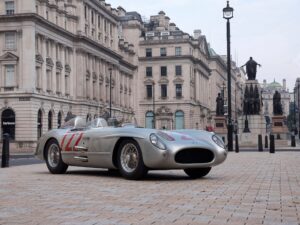
One of our bags is called the Stirling, in honour of Stirling Moss, arguably the greatest British racing driver of all time and definitely the greatest driver to never win the Formula One World Championship. He was runner up four times, three of those to one of the greatest F1 drivers of all time, Juan Manuel Fangio, whom even Moss acknowledged was the best, even though that won’t have lessened the pain of losing.
In 1954, Mercedes Benz made a return to Grand Prix racing and, echoing its pre-war dominance, swept all before it in both F1 and sports car racing, before pulling the plug at the end of the 1955 season.
Moss joined the Mercedes Benz team for the 1955 season, having proven his credentials racing a Maserati 250F in 1954. The season comprised 11 rounds, although four were cancelled after the horrendous accident at Le Mans, when a Mercedes Benz 300 SLR driven by Pierre Levegh was launched into the crowds opposite the pits, killing himself and over 80 spectators.
For six out of the remaining seven races in that truncated season, Fangio and Moss would often run nose-to-tail at the head of the field in what would become known as ‘the train’, Fangio winning four races and Moss taking his maiden GP victory, appropriately at the British Grand Prix.
If Fangio had the measure of Moss in Grands Prix, then Moss had the upper hand in sports car racing, driving the Mercedes Benz 300 SLR which was, in effect, a Grand Prix car with full bodywork and two seats.
Mercedes missed the first two rounds of the sports car racing season, in Argentina and America, but would go on to win the RAC Tourist Trophy in Ireland and the Targa Florio in Sicily (both Moss victories.) The team was leading at Le Mans before the accident, causing Mercedes to withdraw the remaining cars and handing a subdued and hollow victory to Jaguar.
Before Le Mans, however, there was the small matter of the Mille Miglia race to be run. This took place on a circular 1,000-mile route from Brescia in the north of the country, down the Adriatic coast and across to Rome, before heading north back to Brescia, comprising ordinary roads of every type around Italy, over the course of a full day. There were many different classes into which cars and drivers could enter, from diminutive Citroen 2CVs all the way up to the class that would provide the overall winner, the no-holds barred sports cars vying for the Sportscar World Championship, comprising entries from Ferrari, Maserati and Mercedes Benz.
For this race, drivers were permitted to carry a passenger, although Fangio chose to drive alone, as did his second team mate Karl Kling. Moss chose to run with a passenger/navigator and was accompanied by Denis Jenkinson, or ‘Jenks’ as he was known to his thousands of readers in Motor Sport magazine.
Immediately after the second world war, Denis Jenkinson had lived a nomadic life travelling around Europe and competing in motorcycle Grands Prix on his own Norton. Because of his small physical stature, he made the perfect sidecar passenger and, in 1949, rider Eric Oliver and Jenkinson won the Sidecar World Championship.
After that, Jenkinson became the Grand Prix and general motorsport correspondent for Motor Sport magazine, spending months at a time driving around Europe to all the races, writing his reports and mailing them back to England in time for the next month’s issue. He became the authority on racing, along the way befriending Stirling Moss.
When Moss approached Jenks to suggest he accompany him on the Mille Miglia, Jenks readily agreed, the two finding they had similar ideas on how the race could be won. In short, this involved using the passenger as a form of navigator, informing the driver of what bends, obstacles, tricky bits or parts where he could go flat out were coming next, relieving the driver of having to remember 1,000 miles of route himself and allowing him to concentrate on going as fast as possible. The concept has since been used for many years in rallying.
Mercedes Benz did nothing by halves and, for two months before the race, the drivers and navigators thrashed various Mercedes road cars and a test hack 300 SLR around the whole course, subjecting the 300 SLR in particular to every possible stress and strain to see what might break; Mercedes was leaving nothing to chance.
During all this, Jenkinson made copious notes about everything they encountered on the course, grading corners for difficulty and hundreds of other places where time could be gained by knowing what came next on the road, using the milestones that lined Italy’s roads for reference.
Jenks wrote all this information down on a 17-foot strip of paper and had a special case made, in which the roll could be wound from one roller to another, the notes being visible through a perspex window, sealed against the weather with Sellotape.
The cars entered in the Mille Miglia set off at minute intervals, the car’s race number corresponding to the start time. Thus it was that the Moss/Jenkinson car bore the number 733, meaning they left the start ramp in Brescia at 7:33a.m, among the last of hundreds of cars to start.
What followed was one of the most incredible feats of driving ever performed. Aided by Jenkinson’s notes, which he communicated to Moss via series of hand signals – any other form of communication being impossible over the noise of an unsilenced 3-litre straight-eight racing engine – Moss completed the 1,000 miles in 10 hours and seven minutes, at an average speed of just over 97 mph. Don’t forget, this was over ordinary roads, be they flat and – sometimes! – straight along the coastline, through dozens of towns and villages, or winding madly up and over the mountains in the middle of Italy. There were no complicated rules about what work could be done to the car during pit stops, the pits being spaced at intervals around the course; any maintenance work was permitted but, remarkably, the bonnet was never lifted on Moss’ car and it only required new rear tyres twice! (When the car was returned to the factory after the race, the engine was put on the dyno and delivered exactly the same horsepower – 270bhp – as it had when it was brand new!)
It’s difficult, if not impossible, to imagine the stamina required to compete and win in a race such as this. No single corner in 1,000 miles was taken more than once; there was no rhythm to build up. It is all reaction, although Jenks’ notes removed a fair amount of the unknown and unpredictable from the proceedings.
Never mind Moss’ efforts, which were all but super-human; Jenks had a grab handle to hold onto to protect himself from the incessant g-forces but he rarely had time to hold onto it, being busy with his roller map: he simply couldn’t risk losing concentration for one second as both his and Moss’ lives depended on him giving the right signals at the right time. Luckily for the pair, the one time he did miss a signal, due to a newly topped-up petrol tank spraying petrol from the filler cap behind his head onto his neck, was a corner that Moss recognised. Other than that, he stayed with Moss for the full ten hours, through the boiling heat from the hot sunshine and the bellowing engine in front of his feet, the deafening noise and the nauseating smells from the inboard front drum brakes.
It was an incredible feat of endurance by both driver and navigator, setting a race record that would never be beaten. Moss had actually taken one of Fangio’s special ‘stamina pills’ before the race, generously given by Fangio to his rival. Jenkinson declined to take his; he later had it analysed but the chemists were reluctant to replicate it as it contained some unknown South American herbal compounds…!
Such was its efficacy, Moss attended the prize-giving dinner in the evening and then drove overnight to the Mercedes factory in Stuttgart! After ten hours of flat-out racing! Jenkinson had a hot bath and then wrote an account of the race that remains an unparalleled piece of motor sport journalism, written with more authority than any journalist has ever accomplished: there aren’t too many first-hand reports written from the passenger seat of the winning car.
They really don’t make them like that any more!
Italian Racing Red
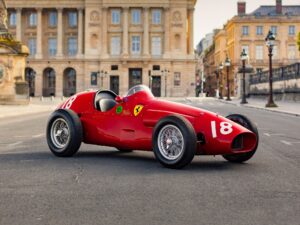
The next of our bags to be featured is the red bag and what does red spell, other than Italian racing?
When national racing colours were handed out at the dawn of motor sport in the early 1900s, Germany was allocated white, Belgium yellow, France blue and the United States red. This latter might seem strange, as red has for so long been associated with Italy and America with blue and white.
Italy only adopted red after a red-painted FIAT won a Grand Prix race in 1907. Quite why the U.S. relinquished the colour is lost in the annals of history but was it because early American efforts in Europe had fizzled out by 1907?
However the change was effected, red duly became the Italian national racing colour, and has a colour ever been so appropriately associated with a nation? Fiery, passionate, emotional; Italians in a nutshell. Wouldn’t have been the same if Italy’s racing colour was yellow, would it?
Enzo Ferrari began his career as a racing driver, before going on to successfully manage and run the Alfa Romeo racing team in the 1920s and ‘30s. Surprisingly, the company that would make his a household name around the world only came into existence in 1949, when the first Ferrari car appeared, (Scuderia Ferrari had been formed in 1929 to run and manage the Alfa Romeo racing team.) From the outset, Ferrari was a racing car manufacturer, selling road cars simply to cover the costs of going racing.
In 1950, the Formula One World Championship was inaugurated. That first year was a walkover for the Alfa Romeo team, racing supercharged, 1.5-litre Tipo 158 models. By 1951, however, Ferrari was winning, taking three victories, although losing the championship to Alfa Romeo and Juan Manuel Fangio.
For 1952 and ’53, races were run to the then-current Formula 2 rules, mandating 2-litre unsupercharged or 750cc supercharged engines. This was because there were simply not enough suitable Formula 1 cars able to compete. It was the making of Ferrari, Alberto Ascari winning six of the eight rounds to take the 1952 title, and winning a further five races in 1953, again taking the title.
From that moment forwards, Ferrari was the major force in Formula 1 racing, frequently challenged and beaten but never matched for reputation.
Of course, there were other Italian teams that were proud to wear the red of Italy; Maserati was the most successful after Ferrari, while Lancia also played a small part in the 1950s. Its radical D50 Grand Prix car was ahead of its time but the Lancia racing division was closed, the company hading over the cars to Ferrari to run under his own banner in 1956.
When a new formula was posted for 1961-onwards, mandating 1.5-litre engines, the British contenders wasted a lot of time complaining and lobbying for it to be delayed, while Ferrari quietly got on with developing his own 1.5-litre engine, understanding that the rules were here to stay, despite the protests of the British.
That gave Ferrari an edge heading into the season and, even though title winner Phil Hill won no more Grands Prix than team mate Wolfgang Von Trips or arch rival Stirling Moss in his privately entered Lotus – two – he took the title along with Ferrari’s first constructor’s title.
By this time, Ferrari was the only Italian manufacturer competing in Formula One – or the only one with any reasonable chance of winning. The driver’s title in 1964, courtesy of ex-motorcycle champion John Surtees, was the last until 1975, the British teams being too strong, most notably Lotus and Brabham.
Ferrari always seemed to be able to let chaos get the upper hand, not to mention the incessant and ever-present internal politics, with Ferrari himself often being told what he wanted to hear by those leading the team at the Grands Prix, often to the detriment of the drivers, or even proper development of the cars. Surtees tired of the politics so much that he walked out of the team half way through the 1966 season.
Famously, after winning the Formula One titles in 1975, ’77 and ’79, Ferrari would not win another driver’s title until 2000, when Michael Schumacher won the first of his five consecutive driver’s titles, after leading the charge to drag the team kicking and screaming towards competitiveness, ably supported by Jean Toit and Ross Brawn, that had started in 1996.
Another title came Ferrari’s way in 2007, courtesy of Kimi Raikkonen but, despite having drivers of the calibre of Sebastian Vettel and Fernando Alonso on the strength, that was the last title to date (2026).